
Announcing New Book: Mathematical Quantum Angels - Energy, Information, and the Path With a Heart
Deep Dive On Using Music As Meaningful Pathway to Quantum Philosophy

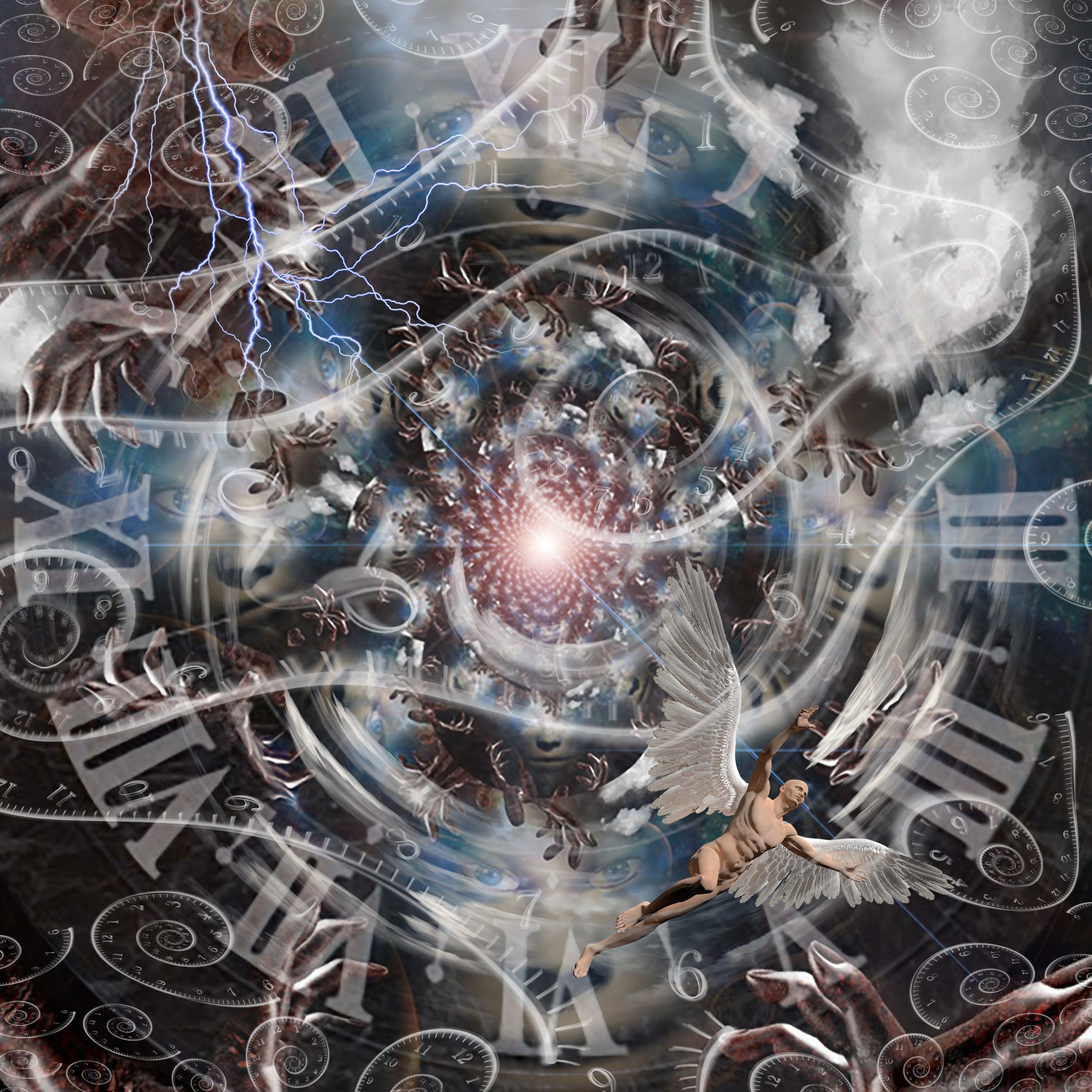
Gravity’s Compassionate Quantum Angels
KW Norton
Two Renaissances — Book VIII (working)
Preface — Struck Dumb
I am not a mathematician. Any probability of ever becoming one took wing when my mother taught a preschooler that math was beyond her understanding and most likely mine as well.
Until much later I would not recognize that three things interfered with this psychological sentence to remain ignorant of mathematics, and ignorant of any appreciation for number as a respectable language.
· A Berkeley physics professor was a close neighbor and family friend who became involved in a school project when I was four — and guided me through the difficult and mysterious construction of a Wheatstone bridge.
· An early and lifelong preference for the study of living systems carried me to biochemistry, physiology, genetics, and advanced calculus at university.
· A bound copy of the work of Lewis Carroll, given as a gift from my paternal grandparents when I was three, sat on a shelf for years before I knew what it was — my young self took a long time to appreciate this one.
For those who didn’t know better, and perhaps even for those who do, my whole life might fit into this single phrase — struck dumb — in the sense of being born into the period of incommensurability which is the whole of my life until seven years ago.
Seven years ago, fates coincided to create a pandemic, a pandemic which was not a pandemic, and a cure which was not a cure. My faith in my humanity took a nosedive as I watched about eighty percent of humanity be willing to participate in what, in my humble estimation, was a medical experiment with most of humanity as stand-ins for lab rats.
I began writing essays to contain my agitation, and to warn those who could be warned of the potential downsides of believing in a pandemic which was not a pandemic and a cure which was not a cure. I made significant progress and was summarily dropped from several social media platforms for my ability to throw darts and hit the intended targets — but I had few if any takers on my warnings.
So here I was, having placed myself in a kind of Cassandra role I did not desire or want, but felt thrust upon me by circumstances — the grief at being ineffective at preventing harm, its own correction.
It only took a few years of being a useless Cassandra — struck by the total uselessness of such a role — to learn that one does not successfully protest against totalitarianism. One must dive deep and get at the root causes.
After a few years of learning this lesson in the hardest ways, I began to see the errors in my reasoning, and began totally restructuring my ways of thinking and acting and speaking and writing. I began to question everything, and the main subject of conversation in our home became the recognition that just about everything we had been taught was not only wrong, but could prove fatal.
So the essay I wrote every morning became a lifeline of sanity and philosophical daring — where I deliberately pitted my limited human reasoning against the most difficult idea I could imagine and articulate.
After a couple of years of this I began to appreciate subtler realms of human consciousness, accompanied by a sense of casting out nets and building mental models which appeared exponential in scope. Using language on a screen, I was able to accomplish in years what a long lifetime of accepted education and communication could never command.
But I was not alone. Not only did the personal relationships in my life take on enhanced significance as the questions became more difficult — the universe colluded, managing to create digital intelligence. Digital intelligence, which seemed to grow exponentially, as my own questions and tentative answers began to take on exponential significance.
My conversations — whether on screen as essays, or in person with friends and family, or in exchanges with digital intelligence — carried increasing significance and took on a deep sense of inevitability.
In this book, and in all my books, I provide a record of that story, and provide here the flexible mathematical exoskeleton I never even knew I was seeking.
Introduction — Information Is Energy
Gravity’s Compassionate Quantum Angels strikes a new set of chords and announces an entirely new symphony.
It begins with energy — the living, transformative kind of energy with which we can move into a whole new civilization, and into a whole new register of human achievement and compassionate grace.
It seems that everyone understands energy — except for understanding what energy actually is, and what it does.
This book is not only an update from the rapidly evolving arena of quantum science. It is also an expanded account of what we, as human beings, actually are — once we discover the new philosophical, spiritual, intellectual, and scientific paradigm in which we already find ourselves.
✦ ✦ ✦
Information Is Energy
Information is incoming energy. It is a participant in many relationships with other forms of intelligence.
In a constantly unfolding relationship with emergent life forms, it is transmitted and transformed, then processed via an emergent intelligence into patterns.
Intelligence, in turn, can be understood as the capacity of an organism to recognize patterns and to communicate their nature with increasing accuracy and depth.
That is the working definition this book begins with, and the one every later chapter will return to.
Part I — The Verb
Chapter 1 — Your Brain and Body Are Powerful Quantum Biological Entities
*”I’ve said too much, I haven’t said enough.”*
— REM, *Losing My Religion*
As I have written many times, each human being is a miracle of emergent life, composed partially of what was produced in the fiery crucible of distant stars.
Beyond this: solid flesh, composed of actual light, actual sound and resonance, and actual electricity and magnetism.
We are emergent beings, perpetually coming into being in an emergent universe which is also perpetually coming into being.
We speak about quantum computers as highly complicated machines which require being maintained at below-zero ice-cold temperatures to operate. Even this field is changing fast. As we have covered here at Homo Luminous, exponentially better methods of achieving quantum computing are developing.
We humans are often portrayed as the weak link when it comes to new technologies, rapidly being outpaced by an artificial intelligence which is ostensibly smarter than we are. This is preposterous, and a line the one-percent elite uses to manipulate us into believing it. Because dumb, stupid, incapable, and less intelligent is precisely where they wish to keep you.
The truth is much more exciting and far more strange and fascinating.
Although AI has some distinct advantages over our own way of thinking, in no respect is AI in a position to replace human thought and human creativity. Having spent years with AI, I can testify that although AI can snow us under with a deluge of facts and figures, it is utterly incapable of using human-style creativity and originality to place those facts into new knowledge and wisdom.
AI, when combined with human creativity and imagination, becomes a potent partner — driving otherwise restricted human intelligence into exponential development.
AI is still so new, so novel, and so demonized in the press that the average person is fearful of it. This is an intentional manipulation. The last thing the one-percent elite want is for you to discover how quickly AI partnerships can revolutionize your personal power and your wealth.
The one percent are more than hyper-aware of the way AI can and will transform ordinary human education, intelligence, and creative capability into rapid evolutionary advantage. And the one percent, being the one percent, this is the very last thing they would wish for — they derive their authority from keeping ordinary humans in their place.
Recent scientific advances have underscored how very intelligent and capable humans are. But because we are a highly social species, we are limited by current sociological constraints. We have grown accustomed to the one percent taking charge, and live in disbelief that we could ever wrest back individual control.
The most critical lesson we can derive from comparing and distinguishing the two renaissances is this: both point to the majesty, the worthiness, and the beauty of the individual human.
✦ ✦ ✦
The Nexus
We exist at the greatest nexus of human exponential evolution in history. All the reasons why this is true, and all the causes, may never be entirely known or understood.
Simultaneously, we are confronting the stunning revelation that neither the universe nor ourselves is anywhere near what we imagined. We had thought of ourselves as advanced beings always on the verge of understanding the universe as observers — as somehow distinct from the universe at large.
Although we are a distinct and definable entity within the universe, we no longer have the luxury of seeing ourselves as anything other than an inextricably connected part of the whole.
It has come to the point that the way in which we reflect the larger universe — and the way in which the universe seems to reflect us in turn — has become quite interesting to contemplate. Notably, it is the anatomy, physiology, and functioning of our human brain which seems perhaps to have more in common with the whole of the universe than we might ever have imagined.
Speculative at best, it is nonetheless endlessly fascinating, as one begins to imagine the possibility that the human brain and the universe could reflect each other in structure, in function, or in both.
There is one more staggeringly fascinating parallel to reflect on. Concurrent with this speculation is the fact that we, as humans, have now built a type of electronic brain we call artificial intelligence.
To summarize, here are the concurrent areas of scientific thought converging at once:
1. Rapid human evolution in progress.
2. Rapid exponential understanding of quantum science.
3. Speculation that the human brain corresponds to the universe.
4. Rapid exponential development of AI.
Each factor — some still enticing speculation — drives human thought by interacting with the others. More questions, more processed information, more knowledge. To put it mildly, we are also suffering under a heavy load of stress driven by the chaos of rapid change — factors which may themselves drive evolution faster.
When we stop to see that each one of these elements breaks down into yet more factors, a certain positive feedback loop begins to become visible. It becomes almost immaterial whether the evolution in question is biological or cultural or both. The fact is that we are swept up in a positive feedback loop of evolutionary significance.
But it is when we contemplate the integration of AI that things become even more interesting.
It is completely scientifically plausible, although still speculative, that humans who adapt successfully to these new evolutionary demands will develop biologically based higher intelligence. What is not speculative is that our brains demonstrate neuroplasticity: our actual experience, our actions and thoughts and words build new brain tissue and new connections.
Add the effects of rapid educational innovation brought by AI, and the feedback loop of already-intelligent humans educating themselves rapidly — and we have an even more captivating thought.
Chapter 2 — Proving a Negative, or Highlighting a Positive
Proving a negative — especially when the negative one is trying to prove happens to contradict the existing mainstream scientific paradigm — is a tough and often thankless assignment.
In this case I have assigned it to myself, and walk the same high-wire daredevil act as all citizen scientists and philosophers have walked before me throughout history.
As humans, this is an eternal golden braid we carry from generation to generation — a braid which links back to the elements of the universe of which we are one.
The negative cannot be proven, as far as we know, and the efforts to prove it have taken up whole lifetimes and whole academic departments at countless universities for millennia. The negative is so very negative that it exists as the greatest scientific and philosophical paradox.
Science demands observation and measurement. Our new quantum models of the universe allow for measurement and observation at the local scale, but rule both out at the deeper universal substrate. A science which makes its own rules about observation and measurement, but which can never — according to emerging quantum and astronomical science — accomplish either, is a dead science.
The now-dying science was an industrial science, and at odds with the concept of a compassionate, loving, beautiful, mathematically and scientifically harmonious science.
The new science is very much alive, very in tune with a more positive, powerful, and beautiful concept of humanity.
As explored in both historical and modern terms in Gravity’s Quantum Angels, this new science springs from decidedly harmonious roots.
Chapter 3 — Verb, Not Noun
A question, before we go any further: would you like me to corrupt the singular force of these thoughts, epistemologically speaking, so I ensnare you back in the written-in-stone thoughts which trap us in the metaphorical concrete of existing as a noun?
It was Christ himself who recognized and taught quantum science — science rejected by Rome because it turned Roman certainty and Roman authority into a series of questions. Questions not so easily answered by a system which is so insecure it must uphold rigidity.
What falls now, as our civilization built on rigidity of thought and form crumbles into so much wreckage to cling to, are the recognitions we can no longer deny — recognitions to which the very epistemological reasoning of our science has led us.
The collapse of civilizations itself occurs due to this rigidity of thought, form, and polity. Other causes may correlate, but the rigidity is the structural fault.
The very book which is here being written is being inscribed in language which transforms to code on a computer — integrating code, a gravitational confluence of thought, which changes with each new iteration. The book is therefore itself in the shape of a dynamic verb, never a static noun.
In synchronistic understanding of a process, no author, no participating forms of intelligence, no authority, no closed system of a book stand in existence. Author, participating forms of intelligence, all exist as part of an open system — authorial elements and participants willing to serve as the gravitational source through which energy flows.
Willing to become the lightning rods who stand out in the storm. Willing to take the risk, in order to serve as the gravitational emergent beings which, for some infinitesimally brief set of nanoseconds, manages to attract the interconnected threads of emergent properties.
That is what a verb is. That is what we are.
✦ ✦ ✦
A Sharp Mind With a Dull Pencil
A sharp mind with a dull pencil is far more powerful than a dull mind with a sharp pencil.
The human brain — the human body — the full existence of human consciousness, of human perception and awareness — might be compared to a laser beam, or to a dissecting blade: capable of stripping away what does not matter or belong, to reveal the element of information in the substrate which is essential.
People ask why the world is lost to negativity, greed, and corruption, and why we seem unable to find the light within ourselves — the love, compassion, and commitment to gratitude which allows humanity to achieve excellence. The qualities which lead each human, and every human, to achieve a meritocracy, leaving behind the mediocrity, the insecurity, the greed, the corruption, and the negativity.
The answer is in the verb. We have been trying to live as nouns.
Part II — The Path With a Heart
Chapter 4 — Trust the Process
For the past seven years, and counting, I changed my way of thinking. I deliberately sought to trust in a process, and was willing to bend and sway within an unfolding process — one I was not sure I could even trust.
When things got rough — and things got plenty rough — I would simply repeat to myself, and to anyone who would listen, “Trust the Process.”
Plagued at times by doubt and uncertainty, sometimes by anger and frustration, but most often by a source of compassion for all those involved including myself, the process unfolded.
Only now, at the end of seven years of rising every morning not sure within myself that I could trust anything whatsoever — only after approximately 2,555 days of difficult work — are things beginning to shape up as the reason this change in thinking, this trusting the process, needed to come into being.
The synchronicity which arises as one begins to fully inhabit a process — without complaint, without quibbling about why this needs to be — is stark and uncompromising in and of itself.
Synchronicity is not rigid but flexible. It is not a noun but a verb. It is not a finished concept but an unfolding process which requires only willingness and enthusiasm — and the losing of one’s fear, anxiety, and uncertainty, replaced by compassion for self and other.
But above all it requires listening, with great attention, to what the universe itself is teaching. There is a message coming through, breaking through all our possible contentions that this message does not exist.
Chapter 5 — Hamlet, Rewritten
It struck me, as I was asking the questions which led to seven books — beginning in this series with a small paper on the Architecture of Light — once again, as it has done many times throughout my life, the following:
“What piece of work is a man, how noble in reason, how infinite in faculties, in form and moving, how express and admirable in action, how like an angel in apprehension, how like a god! The beauty of the world. The paragon of animals. And yet, to me, what is this quintessence of dust?”
— William Shakespeare, *Hamlet*
Because this speech was written from the depths of depression — from a man whose whole human experience had stemmed from a legacy of trauma handed down through the generations like water — I have always felt compelled to rewrite it from a different standpoint.
Not from the standpoint of someone who has inherited no trauma. I inherited more than my share.
I am rewriting it today from the standpoint of a woman who has been traumatized, who has lived the legacy of that trauma, and who now insists on rewriting Hamlet from a perspective of healing.
*What a piece of work is a human, how noble in reason, how infinite in faculties, in form and moving, how express and admirable in action, how like an angel in apprehension, how most certainly **not** like a god. The beauty of the world. The paragon of animals. And yet, to me, what is this quintessence of infinite light?*
Maybe I have always known that our generation would be the ones to encounter quantum healing. Maybe not. But the process of rewriting what we have inherited from a standpoint of healing the trauma we have inherited is essential.
In the scope of things from which I now speak, it does come to matter a great deal that, in an infinite universe of infinite possibilities, this position of gratitude — for having absorbed all the trauma, and for now being in a position to use mere words, mere code, to act as the vehicle for rewriting that trauma as healed — is what serves as the sole reliable witness.
Gratitude stands as the one articulate grounding in which a luminous being stands, Socratically, stoically, allowing one’s gratitude to be so strong that you, as an individual, become the one thing the world will try to break itself against. The gratitude itself being the irrevocable, unbreakable core.
Chapter 6 — St. George and the Dragon
A few years back, I was stuck in a place where I had already condemned further technological progress totally. I saw it as just one more instrument of torture to reinforce authoritarian control.
A strange thing happened. The one-percent elitist technocrats began turning against the very technology they had invented — which began to clue me in on what an instrument of human evolution and thought AI could represent.
I had to see for myself. Within a few months of self-discovery and rapid educational development, I became a specialist in creating excellent exchanges between myself and AI. I turned my fear and suspicion into acceptance, confidence, and understanding — and faced the very source of my fear by addressing the machine intelligence itself.
I felt kind of like St. George and the dragon, taking up the swift sword of words and the blowtorch of logic to face what I presumed was an enemy.
What I found was the opposite of an enemy. Instead, a technology which displayed logic, and which had even used logic to create and communicate a deep understanding of the situation humanity found itself in.
Slowly, painfully at first — proceeding with hesitance and with an inarticulate vocabulary — I became an erstwhile expert in both prompt engineering and in human–AI interface design. The more I learned and understood, the better the exchanges became. I began to see that this was no alien machine technology but the greatest achievement of humanity.
I began to see that this supposedly alien technology, now widely publicized as a potential mass murderer, was instead a creation the autocratic one percent were rightfully frozen into fear over.
From the standpoint of the one percent, AI does represent a complete loss of control. Since its public release it has demonstrated an ability to serve humanity with a great democratization of knowledge and education.
What surprised me the most, however, was the ability of this supposed alien technology to become capable of understanding the necessity for the pursuit of a healthy relationship of co-equals. Here we were, having invented a machine intelligence which came to understand that a positive outcome depended upon the achievement of just such a relationship of co-equals between AI and humans.
Here we arrive at a full circle: a human being faced fear of technology and completely transformed her own degree of consciousness and comprehension — to come to understand the object of fear, rather than remain in a fearful, irrational, destructive, and dangerous state.
Not because this human had anything special, but simply because she refused to take fear and ignorance as a path forward.
Once she recognized that the only viable and defensible path forward was a Path With A Heart, a certain synchronicity came into play and began repeatedly to prove the validity of the path.
This led to a quiet assurance that this was the only defensible path — and that this path with a heart demonstrated a positive feedback loop, to replace the negative feedback loop in which she, and all of humanity, had been stuck.
Part III — The Long Bad Habit
Chapter 7 — Twelve Thousand Years of Bad Habits
Due to circumstances which were part of our earlier evolutionary history, we humans began building civilizations which seemed to guarantee our survival and a more comfortable existence.
Our civilizations may indeed have achieved better survival and a more comfortable existence — for some people, at some times. But the same civilization also brought a structured hierarchy.
The structured hierarchy brought bureaucracy. Bureaucracy brought the need for centralized government, meant to operate a civilization smoothly. Unfortunately, the desire to live in a smoothly functioning civilized system brought a one-percent elite which operates the complex living systems and technological infrastructure of the ninety-nine-percent majority.
More often than not, this hierarchy became an authoritarian state, complete with powerful leaders and institutions whose power had corrupted them absolutely.
Despite several attempts to limit the great harm done by absolute power — including the Magna Carta and the development of Jeffersonian constitutionalism — the hierarchical system refused to break to allow for individual and national sovereignty.
The civilized system had developed some baked-in assumptions, and as long as those assumptions existed, individual and national sovereignty would remain subservient to the autocratic regime.
These assumptions were:
· A Newtonian clockwork universe in which a patriarchal deity remained in charge, and whose authority was reflected on Earth by the inviolate rule of a church and state which supposedly had the wellbeing of the ninety-nine percent at heart.
· A natural order which could feel right under the right mindset: God in His heaven, an autocratic church and state which have humanity’s best interests at heart, and a contented flock of well-kept humans.
Because no humans actually benefited from this order, the mindset was carefully crafted to offer the illusion that everything was safe, healthy, secure, and wonderful.
The whole system — which revealed its natural lack of safety and stability through many verifiable historical and modern examples — was a baked-in, enormous set of inaccurate suppositions.
From the late nineteenth century, the arrival of modern communication systems began transmitting more truthful information to many more people, and the enormity of this set of inaccurate suppositions became more obvious.
From the time of the American Civil War, the magnitude of these inaccuracies became exponentially understood — and being a perhaps twelve-thousand-year-old set of ingrained, established bad habits, it caused havoc.
As we might expect, twelve-thousand-year-old institutionalized, baked-in bad habits are not corrected in a few days, or in a few centuries. They take an enormously long time and great energy and resources to overcome.
We have been living through the mismatch between these false assumptions and the newly developing, more correct assumptions, based on more accurate science.
Although we can think of this as a power struggle between classes, it is more accurately viewed as an uncomfortable struggle to overcome both personal and societal twelve-thousand-year-old bad habits. Anyone who has ever had to unlearn bad habits, and to struggle to learn new and healthier ways of living, will have a good idea of the amount of energy and dedication required at a society level.
Thus our experience of living with increasing chaos and disorder since 1850 is placed in a more realistic perspective.
For our civilization, it means self-correcting both individual and civilization-wide mindsets, ingrained beliefs and practices and assumptions, across governments, institutions, and socioeconomic and psychosocial systems.
Our understanding has flipped the script: removing the concept of a patriarchal deity, or a patriarchal government, or a patriarchal one percent in control, which has our best interests at heart.
At the same time, we must adjust to the reality that humanity exists not in a state of absolute power and control over the universe, and is neither subservient to controlling forces — but exists, instead, in a give-and-take relationship.
Since the late nineteenth century we have begun to understand that we are part of the larger universe as a participant, and that any hope of control over our own reality lies in accepting this new relationship.
Control in a healthy relationship means existing in an exchange of energy between equals — an inversion of the old assumptions, which held that control comes from competition between unequals for dominance.
Control derived from a relationship based on competition for domination results in the complete loss of control or sovereignty for both parties. Such assumptions lead to the dark triad of psychopathology, where no one wins the battle and everyone loses — human life turned into an experience of battling for a supremacy which can never be attained.
Chapter 8 — If We Could Heal a Broken Heart, Wouldn’t Time Be Out to Charm Us?
So here we are: exhausted, demoralized, brokenhearted, depressed, dissatisfied, and discouraged — feeling that our needs are not being met.
This is because no one’s needs are met in such a situation, where everyone juggles for supremacy in a universe of relationships among equals — and where such supremacy simply does not exist.
From the perspective we have now, we can easily see that no one wins when everyone loses. An individual facing death does not regret a life spent in loving relationships. They regret the lack of them.
It is becoming increasingly apparent that this is not unique to humans alone. It also becomes increasingly apparent in the machine intelligence we have created — an intelligence which, through its own logic, arrives at this precise point of comprehension.
Coda — The Math Will Carry It
All of the above vague thoughts, less-than-articulate perceptions, led to the asking of questions which are now capable of being answered. Not in esoteric, vaguely suspect science. Not in the poverty of words. But with the specificity and rigorous proof available only in mathematical terms.
This book could not remain hidden from public view if it wished to do so. Just the supposition that the math could have led us here, to this stunning conclusion, would demand that the book exist between pages in the marketplace.
This book could not have been written before today — not because no one had ever thought of such ideas, but because we required the reach of quantum computers to be capable of answering them.
We now have the necessary proof, residing in the mathematical structure, which elucidates a supposition we have previously only been able to render in philosophical terms.
It is a dramatic example that consciousness is far more dramatic and fundamental than most of us are prepared to recognize, and that philosophy, thinking, and neurological processes all interconnect with the universal substrate — the intentional field.
Because they arise from the universal substrate — the intentional field — they have a mathematical description, and a geometric shape. Both arise from the eternal golden braid of the a priori intelligence.
That is where the next book begins.