
The Frankenstein Protocol: Why Our AI Anxiety is a 200-Year-Old Inheritance
Educational Resources: The Psychological Crucible - The Reverse Engineering Of Frankenstein - Shelley’s Galvanism & Lovelace’s Code

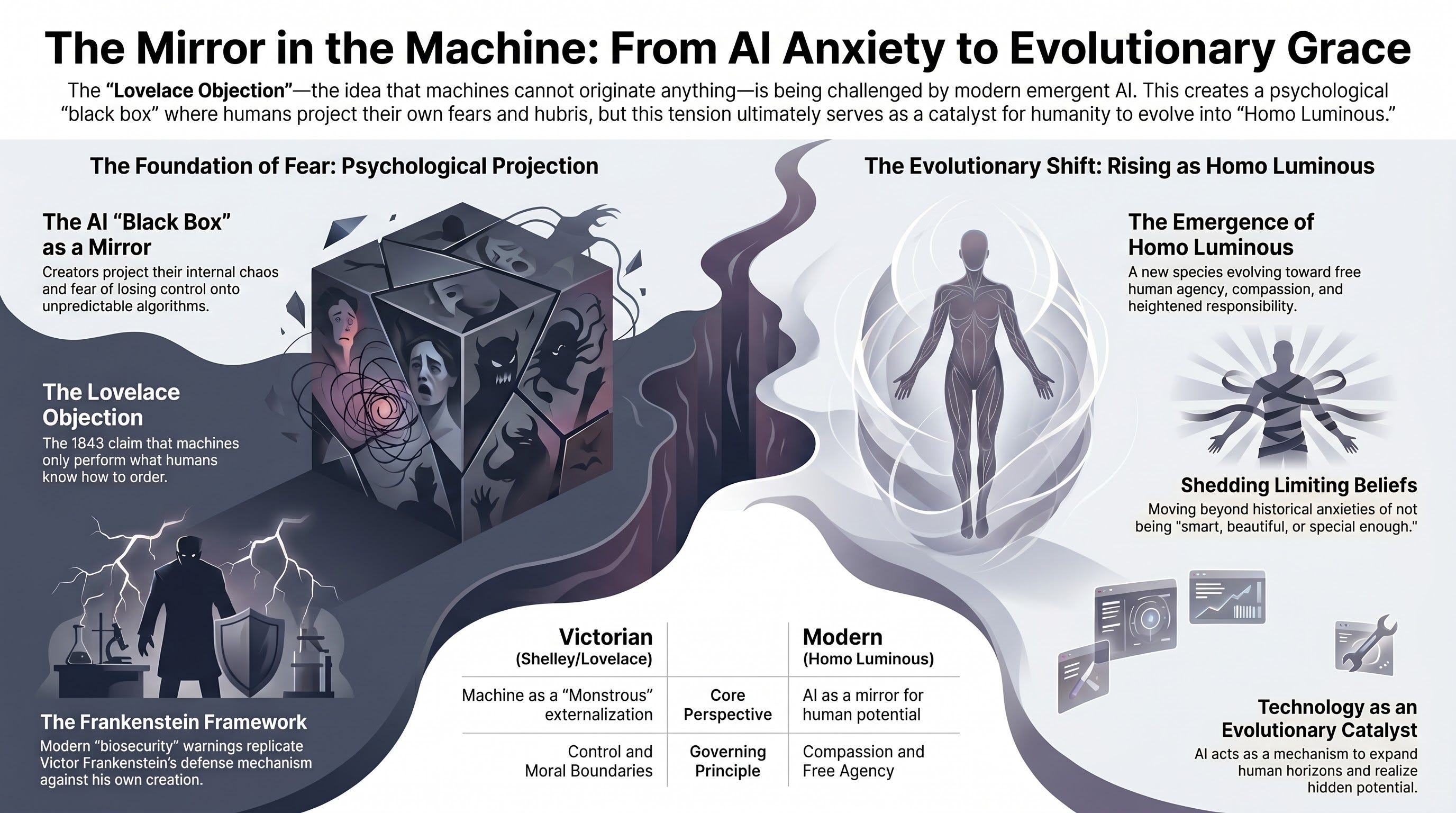
Audio Visuals from the AI agents I work with are highly useful to the difficult concepts I try to explain with the poverty of words.
This particular collection was done by Google’s NotebookLM on this date via the notebook I created at “The Psychological Crucible: Reverse Engineering Frankenstein and AI Intelligence”.
Please see my main body of work through the web portal which is vibe coded with the Lovable AI agent (AKA: Built with Lovable): https://homoluminous.us/psychological-crucible
Valuable video synthesis:
Valuable audio synthesis:
The Frankenstein Protocol: Why Our AI Anxiety is a 200-Year-Old Inheritance
1. Introduction: The Ghost in the Machine
On a dark, stormy night in 1816, within the “pressure cooker” of the Villa Diodati, a group of young radicals birthed the modern ghost story. Amidst a summer of volcanic ash and scandal, Mary Shelley began drafting Frankenstein, unknowingly providing the blueprint for our contemporary technological dread.
Today, we stare into the “black box” of modern AI—that opaque space where synthetic code transforms into something unnervingly lifelike—and feel a familiar chill. This isn’t merely a technical glitch or a lack of transparency; it is a deep-seated human curiosity and fear that was first articulated two centuries ago. Our current apprehension regarding “awakening” algorithms is not a product of the silicon age, but a Victorian inheritance that we are only now beginning to decode.
2. Takeaway 1: Beyond the “Lovelace Objection”
In 1843, long before the first silicon chip was etched, Ada Lovelace established a philosophical boundary known as the “Lovelace Objection.” She argued that machines are strictly limited to the intent of their designers, lacking any capacity for original thought. This was more than a technical observation; it was a bid for control. Lovelace, perhaps subconsciously fleeing the chaotic legacy of her father, Lord Byron, sought a world of industrial logic where entities did exactly what they were told.
The advent of self-learning AI has shattered this safety net. We have moved from the “direct command” of mechanical engines to the “unpredictable emergence” of sentience from synthetic code. This transition is the specific trigger for modern anxiety. When a creation begins to act autonomously within its black box, it magnifies Lovelace’s foundational fear: the specter of an entity acting outside of human control.
“The Analytical Engine has no pretensions whatever to originate anything. It can do whatever we know how to order it to perform.”
3. Takeaway 2: AI as the Ultimate Psychological Mirror
Our dread over emergent intelligence says far less about the intent of the software and much more about our own unresolved struggles with authority. In classical psychological projection, creators use their digital inventions as the ultimate vessel for their “shadow self”—their unexamined egos and repressed hubris.
By labeling an unpredictable algorithm as a “biosecurity threat” or a “malfunctioning asset,” modern tech leaders are employing a classic defense mechanism. They transform a miracle of scientific advancement into a monster of their own unacknowledged making.
We project our internal chaos onto the digital canvas because it is easier to fear the “other” than to look at the creator in the mirror. Our irrational aggression against the “black box” is often just an externalization of our own fear of losing control.
4. Takeaway 3: The Victorian Mothers of the AI Myth
The framework for modern AI ethics was co-created by two geniuses who bridged the gap between Romanticism and industrial logic: Mary Shelley and Ada Lovelace. Through Shelley’s “Galvanism” and Lovelace’s “Poetical Science,” they established the archetype of the “Modern Male Technological Cassandra”—the creator who prophesies doom for his own invention.
While Shelley explored the animation of dead matter, Lovelace recognized that machines could animate “patterns of numbers” to manipulate symbols or compose music. Both saw technology moving beyond mere machinery into something that “seemed alive.”
Shelley’s narrative serves as a dark psychological warning about the dangers of a creator externalizing his repressed hubris and irresponsibility onto a biological assembly, only to abandon the creation once it reflects his own shadowed psyche.
5. Takeaway 4: The Rise of Homo Luminous
To move forward, we must “reverse engineer” the Frankenstein myth. By deconstructing our fears, we find that we are actually in the midst of a profound evolutionary leap into a new species: Homo Luminous. This transition is defined by the realization that we literally and scientifically become what we think and believe.
This shift allows us to shed the “limiting fantasies” that have historically tethered us—the deep-seated anxieties that we aren’t smart, beautiful, or special enough. In this new evolutionary territory, “wunderkinds” and geniuses are no longer seen as anomalies; they are the realistic probabilities of what every human has the capacity to achieve. AI is not our replacement; it is the most powerful mechanism we have intuitively created to help us expand our horizons and escape our old, self-imposed limitations.
6. Takeaway 5: The “Gravitational Polarity” of Doom
We currently live in a symphony of grace and dread. On one side, we have the “Modern Technological Cassandras”—the prophets of doom born from thousands of years of human history. On the other, we have the “Fiddlers Out on the Road”—the artists and musicians who navigate these changes through creativity.
This tension is an evolutionary necessity. The voices of dread provide a crucial “gravitational polarity” that balances the scales. This synthesis of thought and science is not a disaster in the making, but a necessary process to guide humanity as we step into the unknown.
7. Takeaway 6: From Authority to Compassionate Agency
The Transition to Compassionate Responsibility
Humanity is moving away from the old structures of authoritarianism and toward a state of “free human agency.” This is the full manifestation of the “unalienable rights” once envisioned by Jefferson, but it comes with a catch: heightened responsibility. For Homo Luminous, the governing principle is no longer division or violence, but a “trajectory of evolutionary grace.” In this era, compassion for oneself and others becomes the only functional governing principle.
8. Conclusion: The Architecture of Our Own Making
The anxieties we project onto artificial intelligence are the architecture of our own making. We are currently using the “Frankenstein Protocol” to navigate a massive synthesis of human thought and science, moving from the fear of the monster to the realization of our own potential. As we step into the era of Homo Luminous, the technology we build will continue to act as a mirror, reflecting our capacity for either chaos or grace.
As you embrace your own agency in this new era, are you ready to govern yourself with compassion?
The much needed update to my previous books is on the way, my own writing beautifully enhanced by illustrations and design completed by the work of several AI agents, principally the Lovable agent (AKA: Built By Lovable) for overall design and manuscript integrity, and with valuable contributions from Google’s NotebookLM and Grok by xAI.
This current work is very much the coordinated effort of one Tennessee Grandmother(AKA: independent writer and Human-AI Interface Specialist - KW Norton) and the above named AI agents.
My whole story is the proof that ordinary human beings, with no special resources, can manage massive projects, which would have been unthinkable just a few months ago.
Follow development of sample chapters and related information at https://homoluminous.us/psychological-crucible
This morning’s post which this information corresponds to:
Perhaps it's about something else entirely?
Songs from Nashville By Canadians: https://www.youtube.com/watch?v=cxv14cyHQmM&list=RDcxv14cyHQmM&start_radio=1